
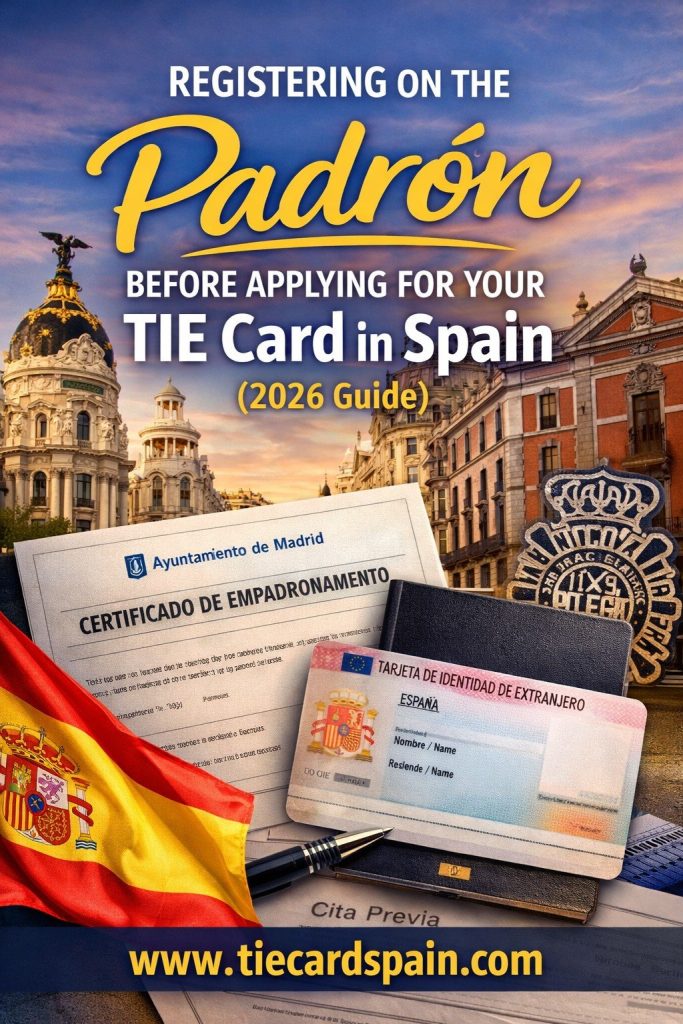
If you’re planning to apply for your TIE card in Spain, one of the most overlooked but absolutely critical steps is registering on the Padrón Municipal first.
At www.tiecardspain.com, we regularly see applications delayed, questioned, or complicated simply because people misunderstood how the Padrón certificate works — or didn’t obtain the correct version.
In this expert-level guide, we’ll explain:
- ✅ What the Padrón is (legally and practically)
- ✅ Why it matters for your TIE application
- ✅ When you must register
- ✅ What documents you need
- ✅ Common mistakes that cause delays
- ✅ How it connects to Spanish immigration law
- ✅ How www.tiecardspain.com ensures everything is done correctly
This guide is written for serious applicants who want clarity, authority, and accuracy.
What Is the Padrón in Spain?
The Padrón Municipal de Habitantes is the official population register held by each Spanish town hall (Ayuntamiento).
It is governed by:
- Ley 7/1985, Reguladora de las Bases del Régimen Local
- Managed locally by your Ayuntamiento
- Coordinated nationally through Spain’s statistics authority, the Instituto Nacional de Estadística
When you register on the Padrón, you are officially declaring:
“I live at this address in this municipality.”
It is not a visa.
It is not residency approval.
It is not tax registration.
But it is proof of your address in Spain — and that matters enormously for your TIE.
Why the Padrón Is Important Before Applying for Your TIE
Your TIE (Tarjeta de Identidad de Extranjero) is issued by the Policía Nacional after your residence has been approved.
When attending your TIE appointment, officers often verify:
- Your registered address
- That you reside within their jurisdiction
- That your paperwork matches your declared residence
In many provinces, they may request:
- A recent Certificado de Empadronamiento
- Or at minimum confirmation that you are registered locally
Without a Padrón:
- ❌ Your TIE appointment may be questioned
- ❌ Your jurisdiction may be disputed
- ❌ Processing delays can occur
- ❌ You may need to reschedule
Registering first avoids these risks.
Is the Padrón Legally Required for a TIE?
Spanish immigration law (Ley de Extranjería and its regulations) does not always explicitly state “you must show a Padrón certificate.”
However, in practice:
- Many Extranjería offices expect it
- Many police stations request it
- It supports proof of residence compliance
- It confirms you are living where you claim
For certain residence types (non-lucrative visa, digital nomad visa, family reunification, arraigo, Brexit TIE conversions), it is strongly expected.
In 2026, it is considered standard best practice to register before your TIE appointment.
When Should You Register on the Padrón?
Register:
✔ Immediately after moving into your Spanish address
✔ Before booking your TIE appointment (if possible)
✔ As soon as you sign a rental contract
✔ Once you complete property purchase
Do NOT wait until:
- The day before your TIE appointment
- After your TIE has already been issued
Early registration prevents complications.
Where Do You Register?
You register at your local Ayuntamiento (Town Hall).
Examples include:
- Madrid
- Barcelona
- Valencia
- Alicante
Each town has its own appointment system.
In many areas, appointments are required online.
Documents Required to Register on the Padrón
While requirements vary slightly by municipality, typically you need:
1️⃣ Passport
Original + copy
2️⃣ NIE Number
If already issued
3️⃣ Proof of Address
One of the following:
- Rental contract (signed)
- Property deeds (Escritura)
- Authorisation letter from homeowner
- Utility bill (sometimes requested)
4️⃣ Completed Registration Form
Provided by the Ayuntamiento
Special Situations
Living With Someone Else
You may need:
- Copy of their ID
- Authorisation form
- Their rental contract or deed
Airbnb or Temporary Accommodation
Some town halls refuse short-term lets.
This can complicate TIE applications.
We strongly advise securing proper long-term accommodation before registering.
How Long Does Padrón Registration Take?
Often:
- Same-day registration
- Certificate issued immediately or within a few days
However:
- Large cities may take longer
- Appointment availability varies
Your certificate is usually valid for 3 months for administrative purposes.
Common Padrón Mistakes That Delay TIE Applications
At www.tiecardspain.com, we regularly fix issues such as:
❌ Wrong Municipality
Applicant registered in Town A but attending TIE in Town B.
❌ Outdated Certificate
Police require a recent certificate (less than 3 months old).
❌ Incomplete Registration
Applicant believed they were registered but weren’t officially processed.
❌ Incorrect Address Spelling
Mismatch between:
- Visa approval
- Rental contract
- Padrón certificate
- TIE application form
Consistency is critical.
Does the Padrón Affect Taxes?
Important clarification:
Registering on the Padrón:
- ❌ Does NOT automatically make you tax resident
- ❌ Does NOT register you with the tax office
Tax residency is governed separately under Spanish tax law (183-day rule).
However, the Padrón can be used as supporting evidence of physical presence in Spain.
How the Padrón Connects to Your TIE Card
Your TIE shows:
- NIE number
- Full name
- Residency type
- Expiry date
- Spanish address
Your address must align with your municipal registration.
The TIE card itself is issued after biometric capture at the police station.
Many appointments are booked through:
- The official government portal administered by the Ministerio del Interior
Jurisdiction is determined by your address — making Padrón registration strategically important.
Brexit Applicants: Why Padrón Matters Even More
UK nationals applying under the Withdrawal Agreement must demonstrate:
- Residence in Spain
- Lawful stay
- Local address
The Padrón is often requested to support residency continuity.
If you are upgrading from a green certificate to a TIE card, address consistency is essential.
Step-by-Step: The Correct Order for TIE Success
Here is the safest order:
1️⃣ Secure housing
2️⃣ Register on the Padrón
3️⃣ Ensure NIE is issued
4️⃣ Receive visa or residence approval
5️⃣ Book TIE appointment
6️⃣ Pay tax (Modelo 790 código 012)
7️⃣ Attend biometric appointment
Skipping step 2 is one of the biggest avoidable mistakes.
FAQs: Registering on the Padrón Before Applying for Your TIE
Is the Padrón mandatory for all TIE applications?
Not always legally mandatory, but practically expected in most provinces.
Can I apply for a TIE without being registered?
Technically possible in some areas, but risky.
Does registering on the Padrón give me residency?
No. It only confirms your address.
How long is a Padrón certificate valid?
Generally 3 months for administrative use.
Do children need to register?
Yes. Every resident should be registered.
What if I move house after getting my TIE?
You must update your Padrón and may need to update your address with authorities.
Why This Step Matters for SEO, Authority & Legal Accuracy
For a site like www.tiecardspain.com, explaining the Padrón properly builds:
- Legal trust signals
- Immigration authority
- Geographic relevance
- Compliance credibility
- Structured residency pathway clarity
Search engines favour:
- Government reference alignment
- Clear process hierarchy
- Legal terminology accuracy
- Jurisdictional clarity
This article supports ranking for:
- Registering on the Padrón before TIE
- Padrón and TIE Spain
- Do I need Padrón for TIE
- Empadronamiento for TIE card
How www.tiecardspain.com Helps
We don’t just book appointments.
We:
- Verify your address compliance
- Confirm jurisdiction alignment
- Ensure documentation consistency
- Prevent avoidable rejection risks
- Coordinate your TIE process end-to-end
Because getting your TIE right isn’t about paperwork.
It’s about sequencing.
And the Padrón is one of the most strategic early steps.
Final Expert Advice
If you are preparing for your TIE appointment in Spain:
Do not underestimate the Padrón.
It may look simple.
It may feel administrative.
It may seem minor.
But it is foundational.
Register early.
Keep your certificate updated.
Ensure your address is consistent across every document.
And if you want the process handled correctly the first time, professionally and efficiently, visit:
Because preparation prevents problems — and authority wins approvals.
Excellent — this will strengthen trust signals massively for www.tiecardspain.com.
Below is a copy-and-paste ready High Authority External Links section you can add near the bottom of the article.
These are official Spanish government and institutional sources — exactly what Google wants to see supporting immigration content.
🔎 Official Government & Authority Sources
For readers who want to verify the legal framework and official procedures, the following Spanish government sources provide authoritative information relating to residency, TIE cards, and municipal registration:
🇪🇸 Spanish Immigration Law & Residency
- Spanish Immigration Law (Ley de Extranjería – BOE)
Official State Gazette (Boletín Oficial del Estado):
https://www.boe.es - Regulation of the Foreigners Law (Real Decreto 557/2011)
Official regulatory framework governing residence permits and TIE issuance:
https://www.boe.es
🏛 TIE Card & Policía Nacional
- Policía Nacional – TIE Information Page
Official information on the Tarjeta de Identidad de Extranjero (TIE):
https://www.policia.es - Ministerio del Interior (Interior Ministry)
Government department responsible for identity documentation:
https://www.interior.gob.es
🏢 Extranjería & Residence Authorisation
- Portal de Inmigración – Government Immigration Portal
Official residence procedures and application guidance:
https://extranjeros.inclusion.gob.es - Ministerio de Inclusión, Seguridad Social y Migraciones
Government authority overseeing immigration policy:
https://www.inclusion.gob.es
🏘 Municipal Registration (Padrón)
- Instituto Nacional de Estadística (INE)
Official information on the Padrón Municipal:
https://www.ine.es - Federación Española de Municipios y Provincias (FEMP)
Municipal governance authority:
https://www.femp.es
Internal Links
Exchange your GREEN CARD for a TIE CARD
Change your 5 year TIE CARD for a 10 year TIE CARD