

Last updated: February 2026
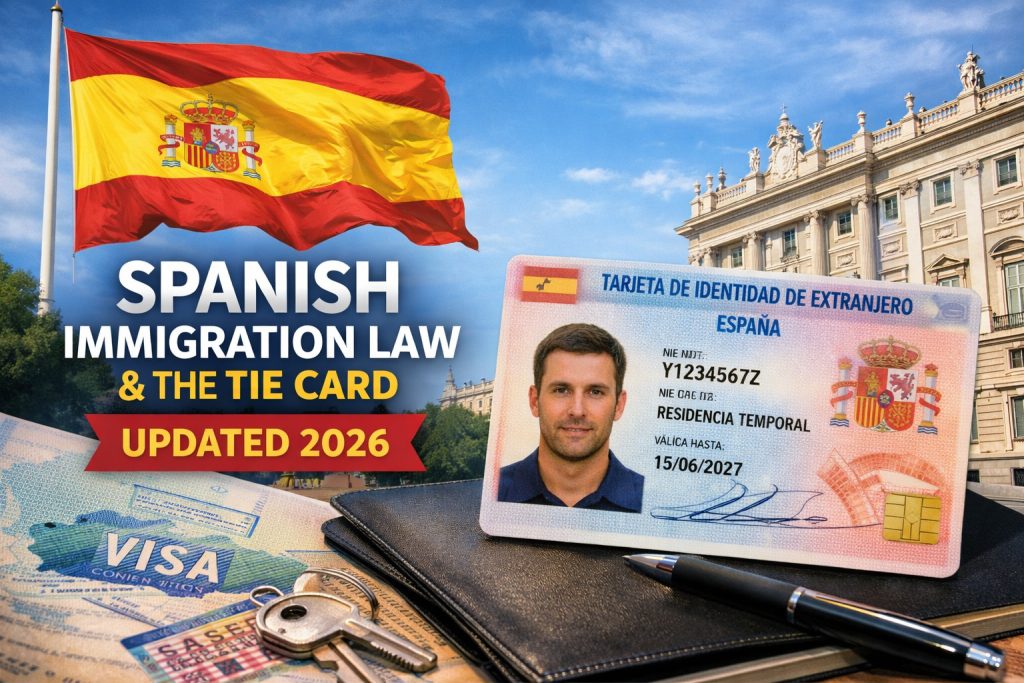
If Spain had a “proof-of-right-to-be-here” badge for non-EU nationals, the TIE would be it. The Tarjeta de Identidad de Extranjero (TIE) is not just a plastic card with your photo; it is the physical proof that your Spanish immigration status exists in the real world — at airports, banks, police checks, renewals, and when dealing with official institutions.
This guide is written to do two things at the same time:
• Explain Spanish immigration law in clear, practical language
• Help you understand exactly how the TIE fits into that legal system in 2026
It is intentionally high-trust, technically accurate, and written for real people, not lawyers or forum speculation.
Important legal note:
This article is for general informational purposes only. It does not constitute legal advice. Spanish immigration law is highly case-specific, and small details (nationality, entry history, criminal records, family links, province, and timing) can change outcomes. Always verify your situation using official government sources or with a qualified professional.
What the TIE Actually Is (and What It Is Not)
The TIE is the official physical identity card issued to certain foreign nationals who are legally resident in Spain for more than a short stay.
A standard TIE card normally includes:
• Your full name and photograph
• Your NIE (Número de Identidad de Extranjero)
• Type of residence authorisation
• Start and expiry dates
• Administrative coding used by Spanish authorities
The TIE is NOT:
• A visa
• A residence approval decision
• The same thing as a NIE
• A green EU registration certificate
Your residence approval creates the legal right.
Your TIE proves that right in day-to-day life.
This distinction matters more than most people realise.
The Legal Foundation of Spanish Immigration Law
Spanish immigration law is built on two main legal pillars:
1. Primary Law
Ley Orgánica 4/2000
This is the core immigration law governing the rights and obligations of foreign nationals in Spain.
Official BOE text:
https://www.boe.es/buscar/act.php?id=BOE-A-2000-544
2. Secondary Regulation
Reglamento de Extranjería – Real Decreto 1155/2024
This regulation explains how the law works in practice: procedures, categories, renewals, documentation, and enforcement.
Official BOE text:
https://www.boe.es/buscar/act.php?id=BOE-A-2024-24099
Why this matters in 2026:
Many online articles still reference the old regulation (Real Decreto 557/2011). As of May 2025, Spain officially operates under the new regulation, and procedures must be interpreted accordingly.
Immigration Regimes in Spain: Where the TIE Fits
Spain separates foreign nationals into two main legal regimes:
Régimen General (Non-EU Nationals)
This applies to most non-EU citizens: workers, students, family members, retirees, long-term residents, etc.
In this regime, the TIE is the standard identity document once residence is granted.
Régimen Comunitario (EU / EEA / Swiss + Family)
EU free movement rights are regulated separately under Real Decreto 240/2007.
Official BOE text:
https://www.boe.es/buscar/act.php?id=BOE-A-2007-4184
Non-EU family members of EU citizens may receive a residence card under this system, but the process and legal basis are different.
Simple rule:
If you are a non-EU national with Spanish residence, the TIE is usually mandatory.
Who Is Required to Obtain a TIE?
You will normally need a TIE if you are:
• A non-EU national granted residence or residence + work
• A student whose authorisation includes card issuance
• A family member granted residence under Spanish law
• A long-term resident (larga duración)
• Renewing, modifying, or replacing a residence card
• Applying for a duplicate due to loss or theft
Having a NIE alone does not replace the TIE.
The Two-Authority System: Why This Confuses People
Spain uses a two-step administrative structure:
• Extranjería / Immigration Office grants or renews residence
• Policía Nacional issues the physical TIE card
This is not optional or informal. Legally speaking:
• The immigration authority decides your rights
• The police issue your official identity document
Skipping the second step can leave you approved but undocumented in practice.
Official Government Guidance on the TIE
Spanish government reference pages:
Ministry of the Interior – TIE Procedure
https://www.interior.gob.es/opencms/es/servicios-al-ciudadano/tramites-y-gestiones/extranjeria/regimen-general/tarjeta-de-identidad-de-extranjero/
Official Immigration Forms (Modelos)
https://www.inclusion.gob.es/web/migraciones/modelos-generales
Police Fee Portal (Tasa 790/012)
https://sede.policia.gob.es/Tasa790_012/
These are the highest-authority sources available to the public.
The TIE Fingerprint Appointment (Toma de Huellas)
Although requirements can vary slightly by province, most TIE appointments require:
• Valid passport (original + copy)
• Residence approval or favourable resolution
• Completed TIE application form (commonly EX-17)
• Proof of fee payment (Tasa 790/012)
• Recent colour passport photo (white background)
• Appointment confirmation
• Proof of address (sometimes requested)
Official TIE form example:
https://www.inclusion.gob.es/documents/410169/2156469/17-Formulario_TIE.pdf
Practical advice:
Always bring copies. Many offices will not make them for you.
Why the TIE Matters More in 2026
Spain and the EU are implementing increasingly automated border and residency verification systems, including the Entry/Exit System (EES).
Official Interior Ministry information:
https://www.interior.gob.es/opencms/es/detalle/articulo/La-Union-Europea-activa-su-nuevo-sistema-de-control-de-fronteras-el-12-de-octubre/
EU regulation reference (DOUE):
https://www.boe.es/buscar/doc.php?id=DOUE-L-2025-81110
What this means:
Clear proof of residence status is becoming more important, not less. The TIE is a key part of that proof.
Rights, Obligations, and “Status Hygiene”
Spanish immigration law grants rights but also imposes obligations.
You are generally required to:
• Carry valid identification
• Keep documentation up to date
• Renew within legal timeframes
• Comply with the conditions of your authorisation
Ignoring expiry dates or renewal windows is one of the most common causes of legal problems.
Best practice:
Maintain a personal residency file containing:
• All applications and receipts
• Approval resolutions
• Appointment confirmations
• Copies of your TIE (front and back)
• Fee payments
• Address certificates where relevant
Common Problems (and How to Avoid Them)
Using outdated forms
Always download forms from official government pages.
Paying the wrong fee
Use the official police portal for Tasa 790/012.
Expired passport
An expired passport can block card issuance.
Address inconsistencies
Some offices expect up-to-date address information.
Appointment delays
Book early and prepare documents before approval arrives.
How TieCardSpain.com Helps After Approval
TieCardSpain.com focuses on the post-approval stage of Spanish immigration.
We help clients:
• Understand what their approval actually allows
• Prepare correct documentation for TIE issuance
• Avoid common administrative mistakes
• Attend appointments fully prepared
Final decisions always rest with Spanish authorities, but correct preparation dramatically reduces problems.
Frequently Asked Questions (FAQs)
Is a TIE mandatory if I already have a NIE?
In most non-EU residence cases, yes. A NIE alone is not proof of residence.
What law governs immigration in Spain?
Ley Orgánica 4/2000 and the Reglamento de Extranjería (Real Decreto 1155/2024).
Where can I verify official requirements?
On the Ministry of the Interior website and BOE.
What is “toma de huellas”?
The fingerprint appointment required to issue the physical card.
Does the new regulation matter in 2026?
Yes. Older articles may be legally outdated.
Can requirements vary by province?
Yes. Local offices may apply procedures differently.
How long does card issuance take?
Timelines vary by location and workload.
Is this legal advice?
No. It is general informational guidance only.
Official Authority Links (Reference)
• BOE – Ley Orgánica 4/2000
https://www.boe.es/buscar/act.php?id=BOE-A-2000-544
• BOE – Real Decreto 1155/2024
https://www.boe.es/buscar/act.php?id=BOE-A-2024-24099
• BOE – Real Decreto 240/2007
https://www.boe.es/buscar/act.php?id=BOE-A-2007-4184
• Ministry of the Interior – TIE
https://www.interior.gob.es/opencms/es/servicios-al-ciudadano/tramites-y-gestiones/extranjeria/regimen-general/tarjeta-de-identidad-de-extranjero/
• Official Immigration Forms
https://www.inclusion.gob.es/web/migraciones/modelos-generales
• Police Fee Portal (Tasa 790/012)
https://sede.policia.gob.es/Tasa790_012/
Links
Upgrade your Green Card to a TIE Card
Immigration Amnesty 2026 TIE card
How the Spanish police make the TIE-Card
What happens to your TIE Card if Spain leaves the EU?